FOREWORD
This
material is selected, re-structured and rougly translated into English
from three places in the printed edition of 1600:
- the
dedication - to Cardinal Aldobrandino - by the publisher Alessandro
Guidotti
- the epistola A'Lettori, letter to the readers, unsigned but
presumably also by Guidotti
- Caualliere's Auuertimenti (notices) to those who would like
to perform the present Rappresentatione, recitar cantando, speaking
it in song.
'The
excellent new COMPOSITIONS in music of SIGNOR EMILIO DEL CAVALLIERE
GENTIL'HUOMO ROMANO are made in imitation of that STYLE , with
which - they say - the ancient Greeks and Romans used to move the spectators
at the theatre to a variety of emotions, affetti. Great applause
has been universally given to this gentleman, who has happily been able
to give new life to the ancient customs or way of doing things. This kind
of music, MUSICA AFFETUOSA, moves people to different passions
such as to sorrows & to rejoicing, to crying & to laughing, and
so on: and it has a particularly strong effect in passing from one passion
to its opposite, as from the sad to the happy, from the angry to the calm,
and the like. And it is surely true that Signor Emilio has the eye for
this sort of Musica Affetuosa and has brought it to the greatest
perfection possible.
'THE
ROOM, to be in proportion for this recitation
in music, should not hold more than a thousand people, comfortably seated
for greater silence and their greater satisfaction: because if it were
to be performed in very large halls it is not possible to make the words
understandable to everyone, without making it necessary for the singer
to force the voice, which lessens the effect: and music like that, where
you cannot hear the words, becomes tiresome.
'LENGTH:
These rappresentationi should not last more than two hours: the
poem should not be longer than seven hundred lines:
DK: Anima
e Corpo has 622 lines, and lasts about one and a half hours
in the
dialogues the propositions and the replies should not be very long, and
a solo narration should be as short as may be. They should be divided
into Acts and experience suggests that three is enough.
'VARIETY:
the poem should be simple, full of versetti (short couplets?) and
not only of seven syllables, but of five, and of eight. There is no doubt
that the variety of roles, personaggi, enriches the stage with
great attractiveness, as does the fact that they are beautifully costumed,
and with variety. All those who have seen these rappresentationi
have judged that things are brought to life to the greatest possible effect,
when there is a little solo singing and then the Choro sings; when
there are different keys, tuoni
i.e. within
a song, rather than between numbers: in Anima
e Corpo almost every number begins with with the same note as the
previous one ended
when at
one moment a soprano sings, then a bass, then an alto, then a tenor; when
the arias and songs are not similar, but varied with many [rythmic] proportions,
i.e. tripla, sestupla and binario; and adorned with
Echos and invention, as much as may be, and particularly the dance,
il Ballo.
'Everything
needs to be done excellently. THE SINGER should have a beautiful
voice, bella voce, well tuned; he should carry it fully, he should
sing with feeling, con affetto, softly and loudly, without elaborate
improvised runs, passaggi;
DK: because
they are contraria
all'affetto: it's clear that some improvised ornaments were normal
everywhere, and Cavalliere gives details how to do them here, but how
many there should be was a controversial question: the one extreme is
perhaps typical of Florence, where the singer's virtuoso ornaments could
get in the way of the poet's message, the other extreme is cantar
alla romana, singing in the Roman style, without any elaborate runs
and in
particular he needs to express the words well so that they be understood,
and accompany them with actions and gestures, gesti & motiui,
not only with the hands but with steps, too, which are a very effective
help in moving the passions.
'It's
good to have a consort of various INSTRUMENTS
- we have so many in our times: they need to be played well, and to be
more, or fewer in number according to the place, whether it's a theatre
or a hall. And so that they should not be seen, they need to sound behind
the scenes, and by people who follow the one who sings: and without improvised
running passages, diminutioni, and fully. To give light from experience,
a Lira doppia, a Clavicembalo, and a Chitarone, or
Tiorba as it is called, together make a very good effect: as also
an Organo suave with a Chitarone. The Sinfonie and
Ritornelli can be played by a large quantity of instruments;: and
a violino sounding the soprano precisely makes a very good effect.
It is good to change the instruments according to the affetto.
'THE
BALLI or MORESCHE will have more of the beautiful
and the new if they are out of the usual: like in the Pastorale di
Fileno, where three Satyrs came to do battle and on this occasion
did the combat singing and dancing: and in the Giuoco della Cieca
four nymphs dance and sing. And if the descendenza di nuvole, the
descent from the clouds, cannot be fitted into the time of the sinfonia
as it should, steps of a Moresca or another dance can be performed.
'This
says nothing about not performing as a finale a ballo formato,
a composed adance: but note well, that the ballo needs to be sung
by the same people who dance, and when it suits they should have instruments
in their hands, and the same people play them too: this will make it more
perfect and out of the ordinary.
Three
Pastorali by Signor Emilio were presented in the presence of
their serene highnesses [the Duke & Duchess] of Toscana at different
times:
- in
1590 Il Satiro, which was performed another time too;
- the
same year La disperatione di Fileno, in which Signora Vittoria
Archilei performed, whose excellence in music is much noted by everyone;
- in
1595 Il giuoco della Cieca, in the presence of Cardinals Monte
and Mont'Alto, and the serenissimo Archduke Ferdinando; with
great, and deserved, admiration; for until that time no-one had seen
or heard anything like it, and they were moved now to tears, now to
laughter
- in
1588 the Comedia grande was performed at the time of the wedding
of the serenissima Gran Duchessa di Toscana.
'The
Rappresentatione di Anima e di Corpo was staged last February in the
Oratorio della Vallicella, with a great audience and applause, a successful
experiment to show how this style is also suitable for moving people to
devotion. The
is the FIRST of them all IN PRINT, and the choice was made
so that both il Secolare and il Religioso can enjoy it.
'TO
BEGIN WITH before the lowering of the back-cloth,
it is good to have a full-sounding piece of music, una musica piena,
with doubled voices, and a great quantity of instruments: the madrigale
no. 86 could serve well, 'O Signor santo e vero'. While the back-cloth
is falling, the two young men who are to speak the introduction, il
Proemio, are on stage. When they have said what they have to say,
Time, Il Tempo, appears: and the instruments which are to accompany
the singers, taking the first consonance, waiting for him (Tempo)
to give the start.
'IL
CHORO, the chorus, should be on stage, partly
sitting, partly on their feet, so that what is performed should be clearly
understood, changing places amongst themselves all the time, and making
gestures, motiui; & when they are to sing, they get to their
feet to be able to make their actions, gesti, and then return to
their places. And while the music for the chorus is for four voices, you
can double them if you like, singing now with four voices, and at other
times together, provided the stage has room for eight, of course.
'IL
PIACERE con li due compagni, Pleasure
with his two friends, do well if they should have instruments in their
hands, playing them while they sing, and playing their own Ritornelli,
the short returning interludes. One could have a chitarone, another
a chitarina alla Spagnuola, and the third a cimbaletta consonagline
alla Spagnuola (a percussion instrument with little bells in the Spanish
style, presumably a tambourine), which makes a bit of a noise; and they
leave the stage as they play the last ritornello.
'IL
CORPO, the Body, when he speaks the words
"Si che hormai Alma mia" and what follows (no.14), can
take off some vain ornament, like a golden necklace, a Penna del Capello,
a hair ornament (chaplet?) or something else.
'IL
MONDO, & LA VITA MONDANA, the World and
Worldly Life, should be most richly dressed: and when they are spogliati,
robbed or ruined (no.43), they show great poverty and dirtiness under
those clothes, demonstrating the embodiment of death, il corpo i morte.
'IL
FINE, the ending, can be done in one of two
ways, either with a ballo, a dance, or without. If you don't want
to do the ballo, you should finish in eight parts with the verse
which is no. 91, "Rispondono nel Ciel ... ", doubling
the voices and instruments as much as possible. If you want to finish
with IL BALLO, you start by singing "Chiostri altissimi"
(the alternative no.91): the stanzas of the ballo are sung
by everyone, within and without (behind the scenes and on stage) and all
possible instruments are put into the Ritornelli. The ballo
starts with riverenza and continenza, followed by other
sedate steps, with trecciate, weaving figures, and passate,
passages, with the whole crowd of people, in a stately way, con gravità.
In the ritornelli, it is done by four people, who dance exquisitely
a ballo saltato con capriole, a leaping dance with capers (steps
imitating a goat), and without singing: and so in all the stanzas, always
varying the dance. And the four masters who dance can vary, now a galliard,
then a Canario, another time a Corrente, as they suit the Ritornelli
very well. And if the stage should not have space for four dancers, you
can at least do it with two: and you should have the ballo composed by
the best masters you can find.
'INTERMEDII:
You can add four performed interludes, Intermedii, one before the
spoken introduction, Proemio, the others one at the end of each
act: but these do not need to be spoken, like a play of the Giants who
wanted to wage war on Jove or anything like that. And you can change the
scenery during each intermedio - which is of course the reason
for them. They are to be done in this order: behind the scenes a full-sounding
piece is played and a harmonious symphony of instruments, vna piena
Musica & armoniosa sinfonia di stromenti, at the sound of which
the movements, moti, of the Intermedii are sounded together,
concertati. There is no need for speaking ...
'IL
SEGNO, the sign  means incoronata, a crowning, which serves for taking breath, and
gives a little time to make some gesture, motivo.
means incoronata, a crowning, which serves for taking breath, and
gives a little time to make some gesture, motivo.
'LE
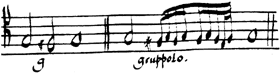
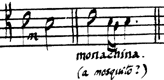
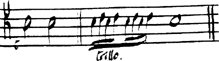
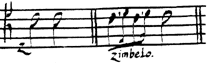
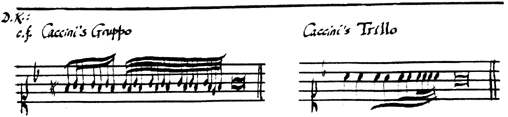
LETTERE, the letters: g = gruppolo, m = monachina,
t = trillo, z = zimbelo:
selection
and translation - David Kettlewell |