For a period during the 1990s, students of Tartu University and others were able to take part in the activities of a group, based on the ideas of the Camerata of renaissance Florence, exploring the power of music and musical thinking to affect the way you feel, in particular the way you feel about yourself, and what you can do - music as a tool for personal growth and even healing, and as a model for human harmony. The name chosen was the Camerata of Tartu, Camerata Tartuensis.
Within this basic theme of creative and empowering pedagogics, activities were very varied, from language work to singing and playing together; there was even a course in practical musicology. Activities were run as an open workshop - everyone was welcome to pop in whenever they could, with previous experience or without, we simply explored the next step for each person, whatever it was; at the same time, work which was followed systematically gave university credits.
Even though the basic driving force was showing people how they could do what they previously believed was impossible, performances included people with all kinds of experiences - the person who might be a complete beginner in one field could be an experienced professional in another, each accepted according their own strengths. In true renaissance spirit, regular Camerata members turned their hands to a wide range of activities, including dress-making, scenery-painting, calligraphy, translation, make-up ... even bread-making ...
 |
 |
 |
|
Mentor
and producer for everything Camerata Tartuensis did was Aasa
Must, reader in Sociology and head of the University's Arts Centre |
Raho
Langsepp was primus motor |
Leader
was guest professor David
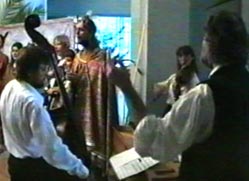
Kettlewell |
It's not easy to say why the work with the Camerata stopped: David took a break of a year to learn all about how to use a Macintosh computer in the service of whole-person education, and after that the political feeling was apparently more towards profiling established Estonian artists than innovative foreign pedagogics.
There's lots of material to present here as a documention of what the Camerata did: we'll begin with the two baroque operas we set up: Polly, where the very real characters can also be seen as symbols of good, of evil, of love, of greed etc.; and Anima e Corpo, where the characters are simply allegories, of Spirit and Body, of Understanding and Pleasure etc., but who can also be seen as having very human attributes and reactions.


