CAVALLIERE's
STYLE |
| stile
antico
|
stile
moderno
|
A variety
of activities in Renaissance times all led to the same goal, a personal
understanding of life, and of death, a HUMANISM
where the individual's experience is real and central - whether it be
aesthetic, emotional or religious.
Religion
as a personal experience was central to Luther's ideas about individual
salvation and the Reformation he wanted to bring about: but similarly
in the Counter-Reformation of the Catholic world, the Roman school of
composers (Nannini, Palestrina, Giovanelli etc.) were setting passionate
love songs to Jesus, as simple singable canzonettas for use at
home.
"Qual
paura, qual danno, o qual tormento
Mi potrà torre a te, mio sommo Amore?
Poi ch'el Corpo, la Vita, il sangue, e'l core
Hai dato per far me sempre contento" |
'What
fear, what harm, O what torment
Can carry me to you, my supreme Love?
Since you have given me the body, life,
Blood and the heart to make me ever content.' |
Luca
Marentio, in Diletto
Spirituale, Roma, 1586
|
And
Cavalliere's Corpo is also someone we can all recognise:
"Ah!
chi mi da consiglio?
A qual du due m'appiglio?
L'Anima mi conforta,
Il senso transporta,
La carne mia mi tenta,
L'eterno mi spaventa ...
Nò nò, che non è giusto ..." |
'Ah,
who is to advise me?
Which of the two to follow?
The spirit comforts me,
Feeling transports me,
My flesh tempts me,
Eternity frightens me ...
No, no, oh, it's not fair ... ' |
THE
FUNCTION OF MUSIC, to make a message clearly
understood, was a main concern of protestant reformers like Johann Walther,
who used popular melodies for singing the psalms to. But it was just
as much a concern for the Catholic Council of Trent, where one party
of cardinals wanted to remove altogether from the church the polyphonic
singing of the Netherlands school of composers such as Josquin, Isaac
etc.: when each voice had its own character, weaving a separate melody
around the others, the listener could hardly understand the words -
until (as 17thC. legend tells the story) Palestrina showed in the Missa
Papæ Marcelli how the syllables could be placed simply and
understandably even in artistic polyphony.
In the
interests of more-effective communication, the northern reformers started
using NATIVE LANGUAGES in the place of Latin,
in education and religion: but even in Rome - where in the Vatican,
Latin is still the living language of the administration, the curia
- Anima et Corpo is in Italian, as are half the spiritual canzonettas
in the 1586 collection.
And
finally, we can see the same concern with music as a means of enhancing
the message of a text, in the sphere of il secolare, the man
of the world, as well as that of il religioso, the man of religion.
The thoughts of the Catholic reformers in the Council of Trent have
their parallels in the discussions of Count Bardi's Camerata
in Florence - as Vincenzo Galilei , Galileo's father and a primus
motor of the Florence Camerata, put it in 1581
'The
modern contrapuntists aim at nothing but a tickling of the ear, without
further thought of the sense of the words ...
'When
the ancient musician sang any poem whatever, he first considered the
character of the person speaking: his age, his sex, with whom he was
speaking, and the effect he sought to produce. These conceptions were
already clothed by the poet in chosen words suited to the need, and
the musician then expressed in the tone, the accents and gestures,
the quantity and quality of sound, and the rythm appropriate to that
action and to such a person.'
'When
you go to the theatre, notice how differences of circumstance affect
delivery, how a man speaks when he is angry, or excited, the married
woman, the lover seeking to persuade his mistress, the man who laments,
the timid man, the man exultant with joy ...; and from your observations,
select what is fitting for the expression of every conception ...'
Once
these ideas were again put into practice, the result was known as stile
rappresentativo; and once that was established by Cavalliere's work,
it became widely used in church music as well as in madrigals and stage
performances.
Music
historians are fond of considering ANNO 1600,
"l'anno del Iubileo", jubilee-year, as the beginning
of the Baroque, the beginning of opera and of oratorio, the beginning
of modern music: the stage work L'Euridice, with music by Jacopo Peri
and Giulio Caccini, performed and published that year, is cited as the
first opera, Anima e Corpo - also 1600 - as the first oratorio,
and MonteVerde's Orfeo (1607) is the earliest work in today's
professional opera repertoire. But it may be useful to recognise that
this is hardly a picture that these gentlemen themselves would recognise:
the productions were called rappresentationi, representations,
"favola i musica" ... "per recitar cantando",
a story in music to be told in song; gradually "opera in musica",
work in music, became just "opera", and "opera nel
oratorio", a work in the prayer house, became simply "oratorio",
but these were later concepts. Caccini's claim, to have been the first
to print songs with just melody and basso continuato, the inner
parts to be improvised by the player, is not disputed, and indeed his
completed Euridice is regarded as the first opera in print: but Peri
claimed that "his" version (presumably the one to which Caccini
composed part) was the first to be composed and performed. Yet Peri
in his turn says that Cavalliere was the first to put 'our kind of music'
(all three of the were in the Camerata) on the stage, in 1594:
while Alessandro Guidotti, Anima e Corpo's publisher, mentions
works from as early as 1590 and 1588. And Vincenzo Galilei was before
them all in studying the Greek background, listening carefully to how
people speak in different ways at the theatre, and defying scorn and
laughter as he experimented to develop, or rediscover, the ancient way
of singing.
Anima
e Corpo, then, was simply seen as one in a line of productions stretching
over a dozen years before 1600, and presenting stories from classical
mythology, like the intermedii in Florence. In these, Cavalliere
was given the credit of having successfully captured the art of moving
the emotions through music: partly, as the other Camerata members
did, by closely reflecting language’s natural characteristics
in the note: but partly also by introducing the larger concept of a
complete story, varied with solo singers of different voice-ranges;
a chorus, as in a Greek drama, to explain the action more clearly; short,
repeated instrumental interludes between verses, ritornelli;
longer instrumental pieces to end each act, sinfonie; varied
tonalities, characters, costumes, scenery, instrumentation, rythmic
proportions, echoes ... But no virtuoso running passages, passaggi
& diminutioni, because these are only used to show how clever
the performer is and obscure the affetto, the feeling or meaning.
WHAT
WAS remarked on as NEW for Anima
e Corpo in 1600 was the demonstration that music could be effective,
not only in bringing people to tears and laughter, but also to devotion;
and perhaps that is why musicologists have identified it as the first
oratorio.
But
with its costumes, properties, scenery, use of space, gestures and dances,
it can seem to a modern spectator more like a renaissance opera than
a baroque oratorio: and the reason Guidotti chose it to be the first
in print was just because it could be enjoyed by il secolare and
il religioso alike.
THE
MESSAGE is the traditional moralistic one;
Anima and Corpo, the Spirit and the Body, like a confused
Hansel & Gretl, are faced with all manner of delightful temptations
- Piacere, Pleasure, Vita Mondana, Worldly life, etc:
Consiglio, Wisdom, Intelletto, Understanding, and Angelo
Custode, a Guardian Angel, all advise them to turn away from temporary
sensual pleasures in favour of lasting joys.
But the
whole thing is irrepressibly optimistic, and the final scene consists
of repeated invitations from the happy souls in heaven and from Intelletto,
to come and join the dance-party - "Non più pensiosi,
Festa, festa per tutto", 'Be thoughtful no longer, party, party
for everyone': and everyone affirms
"Congiungete
Angeli buoni,
Congiungete i canti, e i suoni:
E quà giù la Terra ancora,
Mentre lieta il seno infiora,
Con il canto, e con il riso
Corrisponda al paradiso" |
'Join
together good Angels
Join together songs and sounds:
And down here the Earth still,
While decking happily the bosom with flowers,
With song, and with laughter
Agrees and accords with heaven ... ' |
|
As with
any composer, a good proportion of CAVALLIERE's STYLE
naturally reflects the musical language common at the time. If we look
first at the pieces in the older style, stile antico, the ritornelli
could almost be galliards from a dance musician's note-book; while the
words of the chorus are set almost in contrapunctus simplex
- where everyone has the same simple rythm - although here dictated
by the words of course, the melody is very simple, and there is only
consonance, except for the ornamental dissonance to end a phrase, a
cliché everyone would have expected:
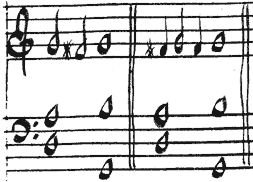
- we
could liken them to Gastoldi's balletti or Lasso's villanelle.
As a
member of the Camerata,
Cavalliere will have shared its view - and that of the Council of Trent
- that complicated counterpoint serves only to obscure the meaning of
the text: but he did nevertheless write a little imitative polyphony,
rather like that of the Roman canzonettas. It is reserved for
festive scenes, like Piacere & Co., and for the angels' invitation
to the mortals to join the party. Other examples are the two short madrigals
in the final scene, played and sung by tutta la moltitudine insieme,
the whole crowd together, where the complex writing - six separate parts,
and imitation the Venetians would recognise - illustrates the majestic
text with an extraordinary surprise effect.
A normal
canzonetta has repeated sections, giving
a form such as AABB, or AABCC: but none of these is used by Cavalliere,
Peri or Caccini in their stage works, presumably because they would
interrupt the drama. On the other hand, both Peri and Caccini do use
a Riposta del Coro, a refrain repeated after different solo verses,
ABCBDB ... : Cavalliere uses instrumental ritornelli in the same
way, but when sung music is repeated it is normally with a new text.
But
it is perhaps in the stile moderno, the modern style,
such as the narrative solos and dialogues, that we notice a special,
charming dialect which sets Cavalliere apart from his contemporaries.
While Peri, Caccini and even MonteVerde let the words be harmoniæ
domina absolutissima, the most absolute mistress of the harmony,
so that today's listener sometimes wonders where the music went to,
Cavalliere's recitar cantando, reciting in song, is always strongly
melodic and related to a recognisable rythmic pattern. Even the melodic
motifs themselves are recognisable, as he lets them return time after
time in varied forms, now in the mouth of one interlocutore,
now in another's.
Later
teachers divided the licentiæ,
the freedoms, of the modern style into two, stile recitativo
and stylus communis which crystalised into the baroque recitative
and aria: but for the most part Cavalliere wrote a happy integration
of the two.
His
harmony is also very special: a very clear
'home' tonality on a bass G - alternating freely between major and minor
to suit the words - so that every departure from there becomes an exciting
adventure, whether it be sadly reflective chorus, suddenly in d-minor,
or his favourite way of closing a phrase, featuring an unexpectedly
lowered bass note, to be contradicted by the same note, but equally
suddenly raised in the soprano:
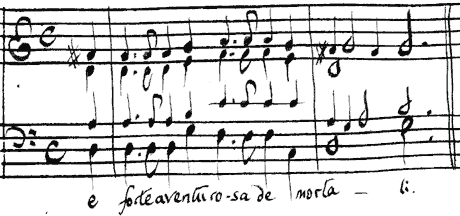
Otherwise
his use of unexpected notes outside the basic scale (chromatics)
is reserved for a very special occasion, such as Vita
Mondana's protest at being stripped naked to reveal her poverty
and falseness, which might have come from MonteVerde's pen:
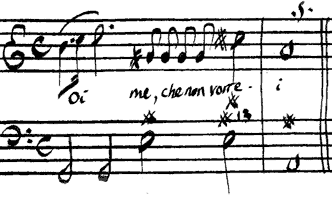
Galilei
makes it clear that excessive 'word-painting',
"il dare spirito vivo alle parole", 'giving a living spirit
to the words' by illustrating them graphically in the notes, only aroused
laughter and mockery, the listeners feeling they were being ridiculed:
but a less extreme form was commonly used, even in stile antico
where it was usually fairly restrained:
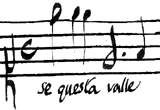
'this
valley' |
Rinaldo
del Mel, in Diletto
Spirituale, Roma, 1586
|
although
more exuberant examples paint the way to the stile moderno:
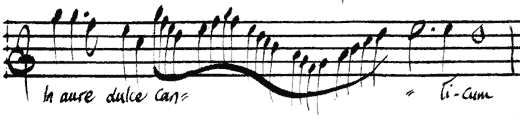
'a
sweet song in the ear' |
Giovani
Maria Nannini, in Diletto
Spirituale, Roma, 1586
|
When
we look at the rappresentationi, Cavalliere was considerably
more generous than either Peri or Caccini, with an example every few
pages, although all three are recognisable as coming from the same aesthetic
world:
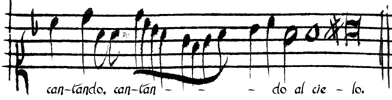
'singing,
siging to heaven' |
Jacopo
Peri, L'Euridice,
Firenze 1600 |

'singing ... '
|
Giulio
Caccini, L'Euridice,
Firenze 1600 |
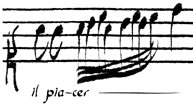
'pleasure' |
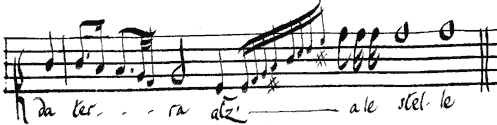
'from
the earth, rising to the stars' |
Emilio
del Cavalliere, Anima
e Corpo, Roma 1600 |
Cavalliere's
example, of lively imagination in the face of stern conformism, is all
the more fascinating when we consider that he was writing at the power
centre of an empire in which inquisition against unorthodox thinking
was at its zenith, and under the patronage of a very senior cardinal.
Welcome
to the world of Musica Affettuosa!


