On two occasions I had rather convincing demonstrations that the system works:
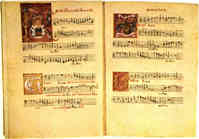 |
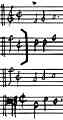
1. As exx.1 and 2 demonstrate, the altus and bassus are on the recto, the 'right', the 'proper', side of a page, the front of a folio ('leaf'), while cantus and tenor are on the verso, the 'back', of the previous folio.
 |
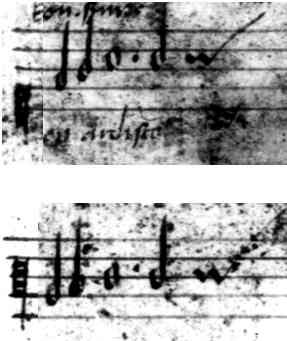 |
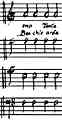
After I had worked out the cantus and tenor which I considered necessary to produce the surviving altus and bassus parts in fragment 3r (r = recto), it was exciting to discover that just those notes I had written were given at the end of the cantus and tenor parts on the back of the same page, 3v (v = verso), as a cue to a repeat of a section from the previous page.
 |
 |
The altus and bassus parts I had written to the cantus and tenor on the back also corresponded to the custodes * at the end of the front page, which also give the cue for a continuation.
Thus it became clear that the front and back of fragment no. 3 belong together as a single piece, so that the total number of pieces is seven rather than eight: and from now on we will refer to them as pieces no. 1 to 7.
2. I didn't notice straight away that the half-page fragments no. 4 and 5 were also parts of a single piece of music, and I treated them separately, producing four different, rather incomplete, pieces.
After a while I noticed a certain similarity between two of the pieces I had written (4v and 5v) and then came the realisation that they fitted together - somewhat late in the day, really, and I felt a bit silly.
The fact that I hadn't spotted the connection between the other pair of pieces, 4r and 5r, was less surprising, because there is a lot missing: but if one then allows for the gaps, the two parts fit there too.

