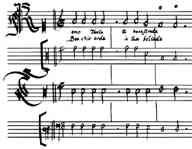
The parts move mostly by step, so that it's possible to complete those surviving parts which lack a few notes, using rhythms which occur elsewhere in the piece.
 |
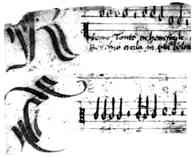 |
Rests create rather more of a problem, but they normally indicate imitation between the various parts, and here again there is seldom more than one possibility.
 |
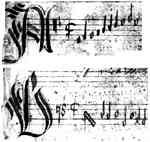 |
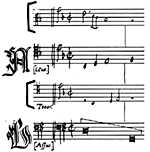
On the other hand, there are many more problems when it is the altus and bassus which have survived: it is easy enough to add a couple of consonant parts, but that is not enough. Altus and bassus parts are only the logical result of the relationship between the cantus and tenor, and in such a case the task is to find those notes in the cantus and tenor parts which make the surviving altus and bassus parts unavoidable, the only possible consequence of cantus and tenor. It is a question of working backwards like a detective, really.
Familiarity with the style helps the detective to identify points where often-used clichés are natural, typically at cadences.

