 |
Since the contratenor altus part was often just called altus, as in ex.2, there can hardly be any doubt that the initials 'T', 'A' and 'B' refer to 'Tenor', 'Altus' and 'Bassus' respectively, and that the pieces were in four parts.
Decoration & voice names
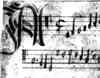
The various processes in the preparing of a manuscript were carried out in different departments of the scriptorium - whether in monastery or town workshop - and a good deal of surviving manuscripts were not completed at every stage; the decorating was normally the last stage, and texts which lack an ornamented initial are fairly common: however this is a less-common example in which the decorated initials were completed, but the text is for the most part missing.
Since the contratenor altus part was often just called altus, as in ex.2, there can hardly be any doubt that the initials 'T', 'A' and 'B' refer to 'Tenor', 'Altus' and 'Bassus' respectively, and that the pieces were in four parts.
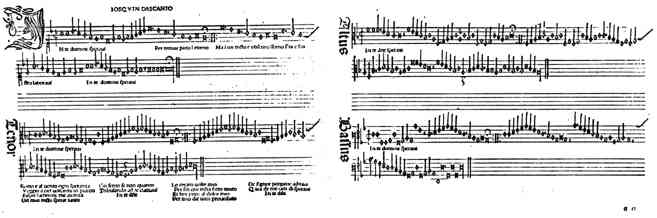 |
ex.2:
Josquin Dascanio [= des Prez] 'In
te Domine', from Petrucci,
Frottole,
Venezia 1504
- click for a closer view, 75Kb
The next step was to see if any of the leaves had been together in the original book, and could thus give the complete four parts of a single piece of music. This turned out not to be the case.
So it seems that we have eight pieces of music, each of them surviving in only two of their four parts - either discantus and tenor, or altus and bassus - and even then some of the surviving parts are not themselves complete: not a very promising basis for a reconstruction, one might think ...
Why the final number of pieces is seven rather than eight is discussed later on.
 |
 |