 |
 |
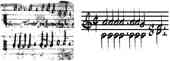
In this example, the upper part is labelled Kyrie, the others Tenor, Contra (='Contratenor altus'), and Bassus (='Contratenor bassus')
Labelling the voices
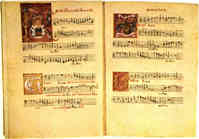
Decorated initials, different clefs, and double bar-lines indicate that each page has two voices, and an examination of the notes shows that the two voices on each page fit together as parts of the same piece of music - rather than, for example, different songs for the same voice to sing.
Manuscripts from the late-15th and early- 16th centuries often have a decorated initial for each part, as in the example on the left: the upper part ('discantus') has the first letter of the text decorated, while the other parts have the first letter of their part-name decorated - a practical arrangement which means that one can see at a glance which piece it is, and where the various parts are on the page: click for a closer view.
In this example, the upper part is labelled Kyrie, the others Tenor, Contra (='Contratenor altus'), and Bassus (='Contratenor bassus')
 |
 |