|
hen I give workshops using Elizabethan texts and the like, people often
ask why 'Shakefpeare' wrote "If Muficke bee the Foode of Love, plaie
on ..."
He didn't
of course; 'Shakespeare' ('Shaksper', 'Shakeshaft' etc.) did indeed write
'Musicke', but the shape of the letter 's' has changed quite a bit over
time. |
| In the early Middle
Ages, the 's' was long, like the 'd' or 'l': |
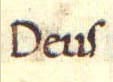
('Deus') |
|
|
From the
later Middle Ages onwards there were two commonly used forms, a long 's'
in the middle of a word or at the beginning, and a short one at the end:

('cisum super aspergis') |
|
| The
long 's' could also used in ligatures such as 'ss' ('double-s'), 'sp'
and 'st':
('littera
ligatura/legatura', a joined-up letter [as a legato style
in music is when the notes are joined up])
'ct'
was a third ligature commonly used:

(esse)
|
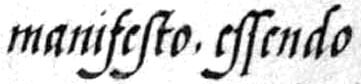
('manifesto, essendo/eßendo') |
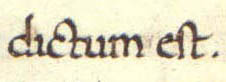
('dictum est.') |
|
-
though you can also see the short 's' in a ligature too,
and the long and short 's' together but not joined: |
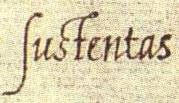
('sustentas')
|
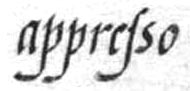
('appresso') |
|
|
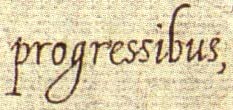 ('progressibus')
|
|
The
'ss' and 'sz' survived into our own times in German printing, and
people sometimes think of it as a specifically German style, but
originally it was used equally in all languages, both handwritten,
engraved and printed from type; though it wasn't always used [left]:
It's still one
of the standard key-strokes on a computer, ß, usually under
the name 'germandbls' (= 'German double-s') and produced by typing
alt+S, although many people see it as a Greek letter 'beta' and
software developers often use it to mean that. |
|
| There's
usually no problem in distinguishing between a long 's' and an 'f'
in handwritten sources: |
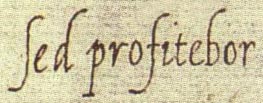 ('sed
profitebor')
('sed
profitebor')
|
|
|
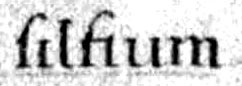
('silfium') |
|
but
the confusion arises in printed texts because when it came to casting
type for printing, the uncial form was taken as a model, the long
's' made with a serif in the middle on the left, like half the bar
across the 'f':
I
can imagine that the long 's' was physically made from a modified
form of the fount used for the 'f', maybe someone can tell
me if that's what actually happened. |
|
| Even
with printed texts there's normally no real problem to tell the
two apart, once you know that there are two forms, similar
but distinct:
But I have seen maybe one case in a thousand where the printer actually
used an 's' type where the word demanded an 'f' (can’t find
an example now, naturally!).
|
|
|
|
It might be worth
mentioning here that 'i' and 'j' were originally two different forms
of the same letter, the second form just written long at the end of
a sentence or group, so that a lower-case Roman number '2' was often
written and printed as 'ij', '13' as 'xiij', '54' as 'diiij'. I suppose
sometime between about 1600 and 1800 they acquired separate names
and sounds in the various languages - if someone tells
me any of the details I'll put them here. |
|
| There's a similar
overlap with 'u', 'v' and 'w', though it's really a different situation,
and has to do with with history of different spoken languages; for
instance, from at least the time of Quintilianus (c. 35-95 AD) there
has debate about whether Apollo gave the lyre of Greek mythology to
'Orpheus' or 'Orfevs' (today's spelling and pronunciation
in Scandinavia). But even if it's clear that they are pronounced differently
in English, for instance, the shapes the earlier printers used to
represent them were sometimes consistently switched around ('bvt euen
... '), and sometimes the printer didn't feel the need to be consistent
('bvt even', 'but euen'). |
|
|
UU
uu VV vv - (examples
to follow) |
|
'W'
is called 'double-u' in English, 'double-v' on the continent, though
you can find both forms in both cultural areas.
It wasn't used in European classical Latin, though a dictionary
of mediaeval English Latin throws up such delights as 'wapentakum'
(not to
mention 'lutestringus', a lute string, and 'cattus
ignis', the fireside cat)
|
|
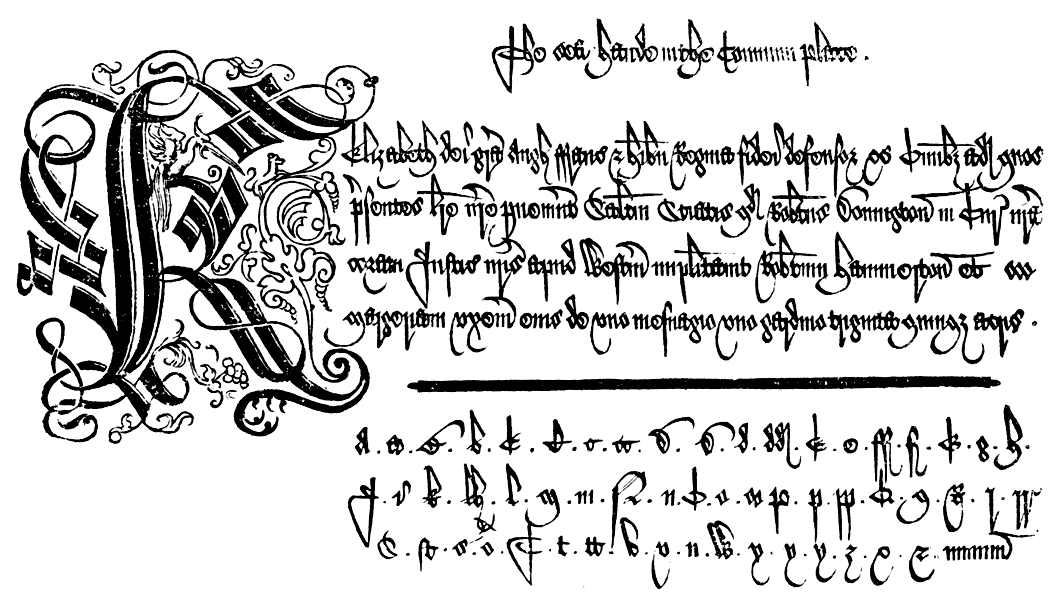
K
is a bit special: it wasn't used in Latin, but was taken over from
Greek in such key words as 'kalends', calendar, so it's virtually
always there in alphabet samples. Interesting that in the English
version of John de BeauChesne's handwriting book (London 1602),
the text sample which continues after the decorated letter 'K' isn't
a word that begins with a 'k', but ... Elizabeth ...
Was it perhaps
adapted from a text about her father or brother which started
with 'King'? - seems a bit far-fetched ...
|
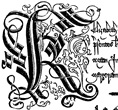
click for a closer view
|
|
|
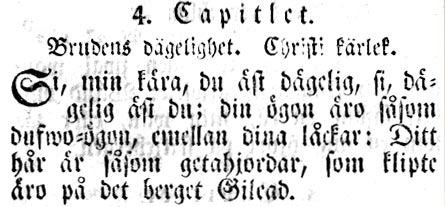
(from the Song of Solomon: 'Behold, thou art fair, my love' etc.)
|
The various accents come
from classical Greek and Latin usage, but the umlauts ('altered
sounds') in German and Scandinavian were originally the Latin diphthongs,
like 'æ' and 'œ', later printed with the second vowel placed
small on top of the first letter. This form was still to be seen in the
main text of an 1857 Swedish Bible, though the font used for the sub-headings
(line 2) uses the two dots: The
Swedish 'å' (pr. as in UK 'raw'/'course'/'naughty') seems to have
been written like that from the beginning (16thC. at least), as an 'a'
with a letter 'o' on top, though nowadays it's described as a circle.
The tilde
(from Latin 'titulus') in Spanish, as in niña,
(girl) started off as a double-n, as in 'ninna', then the second
'n' was sometimes left out and shown by the abbreviation, standard in
the Latin-based world, of a little line above the first 'n', more or less
curly depending on the writing style, which then become accepted in both
writing and printing and given its own name, eñe.
|
|
The net result
is that there are plenty of alphabet samples from earlier times
which are complete in 23 letters:
while others give
various combinations of long and short 'i' ('j'), perhaps a 'w'
or 'uu' and perhaps a rounded 'u' as well as the pointed 'v' |
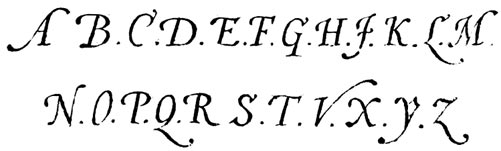
(from John De BeauChesne, London 1602)
|
|
|