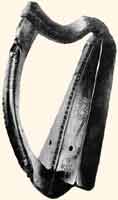
The Queen Mary Harp
-
click for a closer view |
The
carving on the Celtic harp must be related to the painted decoration
of the soundboard, and this applies also to the Minstrel harp. A good
example of carving suitable for the front pillar of a modern Celtic
harp may be seen on the Queen Mary harp now in the National Museum
of Antiquities, Edinburgh. According to tradition, the instrument
was in the possession of Mary, Queen of Scots, when she was on a hunting
trip in the Perthshire highlands in 1563. The queen is said to have
taken this occasion to present the harp to a Beatrice Gardyn of Banchory
(later Mrs. Farquharson of Invercauld).
At
a later date, the marriage of a female descendant of Beatrice brought
the harp into the Robertson family, of Lude, Perthshire. The instrument
remained in the same family until about 1904 when it was purchased
at auction for 850 guineas by the Museum. The soundboard of this precious
harp is thought to have been decorated with a portrait of the queen,
the arms of Scotland in gold, and a goodly number of valuable jewels
... these ornaments were, however, stolen or lost during the rebellion
of 1745.
The
Queen Mary harp has relief carving, incised lines made with the parting
tool, and poker work burning. The amateur harp maker would be well
advised to take it as a model. One of the interesting features of
ancient Celtic harps was the double-headed fish carved on the front
pillar and according to legend it represents a mythical salmon, one
head listening to the music of this world and the other head looking
up, offering it to God.

