"As in former time, whien the Semibrief and Minim were the least Notes, the Brief was the Measure-Note, or principal Time-Note; ... so since the the inventing of the smaller Notes, (the Brief growing by little and little out of use) the Semibrief became Measure-note in his stead [= instead] ... The Time-stroke of the Brief, Lystenius* termeth [calls] Tactus major, and of the Semibrief Tactus minor"
(CB.28)
There is normally no problem in deciding whether the tactus-note or measure-note is the breve or semibreve in a particular piece. If you try both possibilities you will surely find that one of them works much more convincingly than the other, and if there are words,their character will settle any remaining doubt.
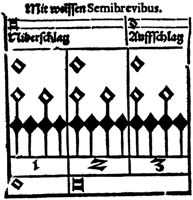 |
|
'Ternary measuring of the notes:
of triple proportion': |
(MB. ibid.)
"Tempus
perfectum [= perfect time]:  "
"
(FG.aa viii)
" ... when
three semibreeves [go] to the Breefe... his sign is a whole
cirkle ... thus.  "
"
(TM. 18)
'It is called perfect because it is measured by three..., three being the most perfect number because it takes its name from the Holy Trinity, which 'is true and pure perfection'
(FC, in SSR.142)

