4
The American Oxford team seem to have even redefined the concept of dictionary, since while looking up school, I also found a potted biography of the composer Schoenberg, just a few lines to tell you why people might talk about him, like the names and dates of the piece which first used atonality, and the piece which first used serialism. Seems a bit extreme though that there's simply no entry for anything starting with 'Schö...'. Actually even Monteverdi's in there too, 'noted for his use of harmonic dissonance'.
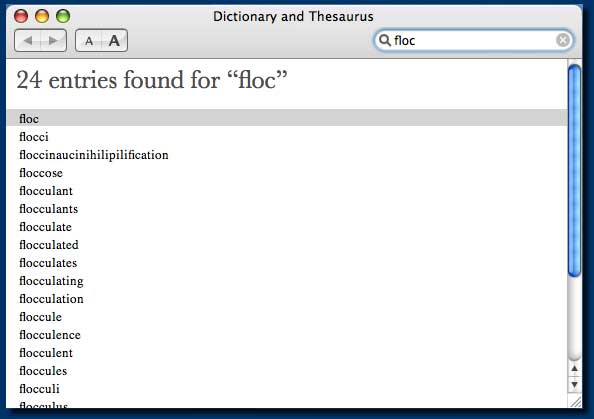
Until I know how stable it is I've only installed Tiger on Titania, my second-hand titanium PowerBook, but it seems I have to have her going alongside everything else as my immediate look-up source and plaything - whenever I get a bit bored with what I'm doing I just turn to Titania, type in a few letters, and learn something completely new and unsuspected. The look-up function works by filtering, i.e. when I start typing dictionary, it gives me - 10,740 entries for 'd' - 2887 for 'di' - 101 for 'dic'
- and of course by then I'm already lost because I don't know any way of getting on with the rest of life until I know what things like dichlorvoses and dicentrics are (it seems some chromosomes somehow have two centres), and what the difference is in English (sorry, American) between dichasia and dichasium (there isn't any, they have the same definition though there's no reference from the one to the other, something botanical to do with trees which have symmeticral pairs of branches). Oh, and dichlorvoses isn't dichlo- anything, but rather boringly a chemical term made up of 'di-' and 'chloro-vinyl' something or other ...
I suppose it would cost rather a lot of money to buy something of this quality separately in digital versions.
 |
 |