
J.J. van Eyck
Den Nachtegael
ABOUT THE PIECE
The original piece seems to be a song about the nightingale, the symbol of musicality in Western poetry - a 17th-century keyboard arrangement that song has been published in a modern edition, but it isn't well known today in that form.
Then a musician in 17th century Utrecht, Jan Jacob van Eyck, published a collection of popular tunes with large numbers of variations, set for the recorder but of course playable on any instrument: Den Fluyten Lusthof, Amsterdam 1649 (if I remember rightly, my sources are in Estonia, I'm in Sweden just now).
They were printed with just the melody, and most recorder-players today play them without accompaniment for that reason; these instrumental versions are played rather a lot and the Nightingale in particular has become rather popular today, as a solo imitation of the bird - though actually it's an imitation of a song about the bird... :-)
But for me it makes much more sense to support the treble/discant/melody with other instruments - harpsichord, lute, harp, organ, guitar, viola da gamba, whatever; everyone knew these tunes, so there was no need to make the book more expensive by duplicating the bass part...
Nowadays there aren't so many people who can look at a tune and play the harmonies which belong with it, so I have written basses to a number of these pieces - they're part of a tutorial book I've been writing on and off for years to help people improvise.
Then I heard two good friends - Reet Sukk and Taavi-Mats Utt, from Tallinn - play this Nightingale piece with two recorders, one at each end of the room, like an echo: first one of them plays the 'A' section as a solo, then the other plays the repeat as a solo, the first plays the 'B', the second plays the repeat etc. I've worked a lot with discovering how people composed music in the 16th & 17th centuries, so it was natural to put all these things together - instead of the one player being silent while the other is playing, it's more natural for him/her to play an accompanying part, below the melody and above the bass; and then on the repeat, they exchange parts, as was rather normal in the 17th century.
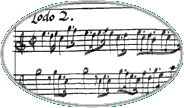
I've just come across another version, as I was preparing for an TV feature about a 19th-century harpist from northern Sweden, who played and visited players in Britain: it's in Edward Jones' Musical and Poetical Relicks of the Welsh Bards, London 1805; he gives an older version, and one in use in hs time. You can see the beginning HERE, and let me know if you'd like more of it.
|
BACK to
DenNachtegael MAIN PAGE |
|
|
|
|
