
Salomon Eklin
Polonaises & Minuets
ABOUT THE COLLECTION
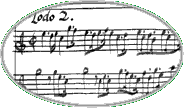
Music manuscript no. 7 in the provincial library of Växjö in Southern Sweden is a collection of three part-books containing about 160 polonaises and minuet, roughly half of each, by Salomon Eklin, who was music teacher at the gymnasium there; the title pages are labelled Violino Primo, Violino Secondo and Baßo. The title pages are dated 1772, but there are tunes in the books dated between 1770 and 1788; to the title page of the bass book is added "24th December" - an interesting way of spending Christmas Eve ...
The pages are 16.5 cm wide and 12.5 cm high - 'landscape' format, rather small and convenient, perhaps portable.
A few of the minuets are credited to other composers:
The polonaises seem to be all by Salomon Eklin; most of them have the spelling "Poloneße", a few have "Polonois". The path from 18thC polonaises to the Swedish folk dance polska is traced by Anders Rosén in his suite of recordings on the Hurv label, www.hurv.com
The Växjö library staff were kind enough to provide me with a photocopy, which I cut and pasted and bound to make a kind of home-made facsimile edition. With the ensemble Musica Colorata I have played through the whole collection direct from the books just as they are: the experience is rather exciting, and rather satisfying musically, except that the bass parts are missing for about 10% of the pieces, and there are a good number of mistakes in the copying which make the harmonies feel pretty uncomfortable at times ... indeed some of the second parts feel as if they were composed by a pupil and never got checked by the master ...
So what I have done here is
It's in the spirit of the times to play the pieces on whatever instruments you have available; the bass can be rendered on a single-line instrument like cello, bassoon or double-bass, or by a polyphonic one like guitar, harpsichord, piano, harp or organ; the upper parts are often rather idiomatic for violin, but many work well on a clarinet - also used in traditional folk music Sweden as an alternative to the violin - and no. 129 bears the inscription "oboë" in one bar to show how an oboist would play differently from the violinist.
You can hear my own interpretations here.
David Kettlewell
|
|
|
|
|
|
