When
stringing your harp, you should start with string No.1 at the top
and proceed downwards. If you start with the bass strings you will
find that the strings are constantly getting in the way of your fingers.
First
insert string No. 1 through the top of the soundboard, and pull the
string right out of the soundbox through the elongated hole at the
back.
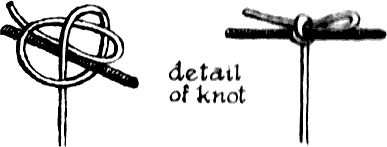
Make
a knot as shown here. In the knot, insert a short piece of 3rd or
4th octave string. Pull the string back and cut it 50 or 60mm above
the top part of the neck.
Now
thread the loose end through the hole in the tuning pin, and take
your tuning key and wind the tuning peg forward. The string should
make at least three turns around the pin, and the loose end of the
string should be caught under the turns. Don't forget to place the
string in the notch of the appropriate bridge pin.
Wire
bass strings have a loop of silk at one end through which a short
wooden peg may be inserted instead of making the normal knot.
Tighten
the string and proceed downwards, without attempting to tune the harp
at this stage. The thick strings and metal covered strings of the
fourth octave downwards do not need to be locked.
Leave
the strings under tension for an hour or so, then start tuning.