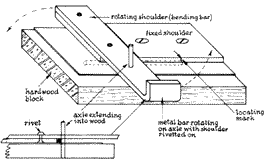
Fig.
5.2 - click for a larger view
|
Mark this position carefully on the wood of the neck, just behind
each string. If you provide your harp with semitone hooks for all
strings, you will be able to tune it in the key of E flat, and play
in eight major and five minor scales when you are used to the instrument.
The real beginner should tune his harp in the key of C natural at
first, then proceed to the key of F natural. After a few weeks, tune
the harp in E flat.
If
you have decided to adopt the hook or blade systems,
a gauge must be made and it will greatly assist in finding the position
of each hole for the axle of the blade or hook. No slackness should
be tolerated, but the blade should nevertheless rotate easily. Put
some candle wax on the shanks before inserting them in the holes.
For
the lever system this is not necessary because there
are no holes to be drilled, as the lever brackets are simply screwed
between the strings. The brackets could be made in stainless steel
or aluminium; one of the readers of Woodworker, Mr. Dennis
Miller, has devised a jig for making hooks and we are pleased to illustrate
it in Fig. 5.2.

